1907 · Deepwater + Tidewater = The Virginian

The Virginian Railway.

Known as the “Richest Little Railroad in the World,” the Virginian was formed in 1907 through the marriage of the Deepwater Railway in West Virginia and the Tidewater Railway in Virginia — the secret project of one of the wealthiest men on earth.

The Virginian Railway logoThe story

A railroad built without regard to cost.

Financed by Henry H. Rogers — one of the wealthiest men in the world — the Virginian proved itself a modern, well-engineered railroad that could operate more efficiently than its far larger competitors. It ran 443 miles from Sewells Point on Hampton Roads, Norfolk, Virginia, to Deepwater, West Virginia, and existed from 1909 until 1959, when it was bought out by Norfolk & Western.

Directness of route was the primary goal of the engineers who planned the Virginian's path. To achieve it, the mountainous terrain had to be overcome with a series of tunnels, bridges and cuts. More attention was paid to grades and alignment than had ever been given to the building of a railroad. “Nothing is too good for my railroad,” said Rogers.

Unlike established systems that routed lines to reach populated places and built piece-by-piece as money allowed, the Virginian was planned with the resources of one man to use the fastest possible route for hauling coal. It became the model for railway improvements on some of the oldest and largest systems in the country.

The work began in West Virginia under the name of the Deepwater Railway Company, with William N. Page as president. When Rogers took a hand in directing its affairs, his first act was to have the charter amended to extend to the West Virginia boundary line; the company's charter was revised in September 1902. About a year and five months later, the Tidewater Railway was chartered in Virginia, its boundary extended to the line of the two Virginias to connect the two railways. W. N. Page became president of both railways. Rogers' ownership of the two projects did not become public until 1907, when the Virginian Railway was incorporated. Sixty-four percent of the excavation in West Virginia was solid rock — most of it moved by hand labor, mules and carts, aided by some 50 steam shovels, 1,200 dump cars and 124 locomotives. At the height of construction, more than 10,000 laborers were employed.

At the time construction began there was not a single mine on the main line. By 1933 the Virginian had developed 91 mines, and shared in developing 47 more on connecting lines — a total of 138 working mines feeding the “Richest Little Railroad in the World.”

The Virginian, in pictures

Building the “Richest Little Railroad in the World.”

Rare photographs from the construction and early years of the Virginian Railway — the line Henry H. Rogers built across the mountains of West Virginia.

1907Virginian Railway formed from Deepwater & Tidewater
443 miDeepwater, WV → Norfolk, VA
10,000laborers at peak construction
138working mines by 1933
1959merged into Norfolk & Western
On display

The collection.

We feature the Virginian Railway, with other roads represented too — including the Norfolk & Western. Explore artifacts, artwork, books and photographs across the museum.

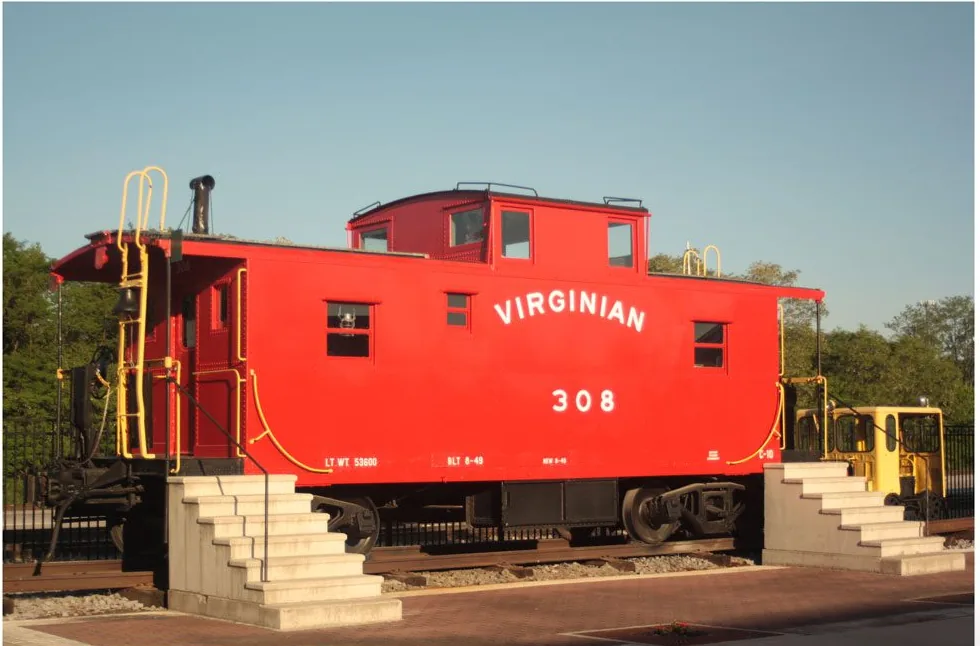
Restored Virginian Railway Caboose #308🚃 Caboose #308

A restored #308 Virginian caboose is open for visitors to explore — climb aboard and see the cupola, bunk and stove where the crew rode.

Hands-on · board it
Railroad lanterns and lamps🏮 Artifacts

Signal lanterns, tools, china, timetables and telegraph equipment — the everyday gear of a working railroad.

Galleries
Railroad artwork on display🖼 Artwork & photographs

Original artwork, historic photographs and maps documenting the building of the line and life along the rails.

On the walls
Museum gallery interior🧩 Kids' corner

An area for children to build their own track, work puzzles and read railroad storybooks.

Family friendly
Books and reference display📚 Books & research

Railroad books and reference materials — a resource for enthusiasts, modelers and family historians.

Reference
Museum gift shop🎁 Gift shop

Railroad books, prints and Virginian Railway keepsakes. Every purchase supports the museum.

From our collection

Stories on display.

A closer look at some of the pieces and exhibits you'll find inside the museum — each with its own story from the age of the Virginian.

Restored VGN Caboose #308
Rolling stock

VGN Caboose #308

The VGN 308 was one of twenty-five cabooses built by the St. Louis Car Company in 1948–49 for the Virginian Railway, numbered 300–324. It was donated by Norfolk & Southern to the City of Princeton in 1989 and, in the fall of 2010, brought to its new home here at the museum.

We've had the floor repaired and the caboose repainted — did you know there's a special shade of red just for cabooses? It's called “caboose red,” appropriately. Come by and see it in person. Thanks to Bo Barker and the men of the Princeton Public Works Department for the hard work.

Railroad lanterns, lights and lamps
Artifacts

Lanterns, Lights & Lamps

The museum holds an extensive collection of lanterns, lights and lamps — electric lamps, gas lamps, steel lamps and brass lamps. What you see on display is only a small sample of the full collection. Come by the museum to see these and many more.

The Princeton Railroad Museum painted a fresh shade of blue
True blue

A fresh coat of Princeton blue

The museum wears a fresh new coat of paint — a deep, confident blue chosen to reflect the city of Princeton, WV itself. Our thanks to Bo Barker and the crew of the Princeton Public Works Department for all their hard work.

Come see the color in person, then read the full history of the Virginian Railway that gave the building its purpose.

Mark Twain, portrayed by a living-history reenactor at the museum
Living history

Mark Twain rides again

On our anniversary celebrations, living figures from history step off the page. Mark Twain, Abraham and Mary Todd Lincoln, Chief Seltoe’e and Harriet Eliza Lathrop are all brought to life by local reenactors along Mercer Street.

Their stories connect to our own: Twain’s closest friend was Henry Huttleston Rogers, the Standard Oil magnate who financed the Virginian Railway — so the author’s tale and the railroad’s are, fittingly, entwined.

Princeton Times newspaper feature: Railroad Museum open again, July 2021
In the news

Open again — and growing

After more than a year closed during the pandemic, the museum reopened in July 2021 with big plans: a new model-train room featuring passenger, coal and timber trains, historical markers along Mercer Street, and a 15th-anniversary celebration.

“Without the railroad, Princeton's history would be very different.” — the museum on the line's role in founding the city. Come see what's new.

Railroad art on display
Gallery

Railroad Art

Fine pieces of railroad art are on display throughout the museum and can be viewed during our normal hours — a painting hanging downstairs, a sculpture upstairs, and more. Original works that capture the romance of coal, steam and steel.

Railroad locks, keys and badges
Security on the rails

Locks, keys & badges

Safety and security went hand in hand on the railroad. The museum houses a collection of locks, keys, badges and other security essentials that railroad police used to keep the railways safe. See these and many more security tools on display.

Historic Mercer Street

The Five Museums of Princeton.

The Railroad Museum anchors a cluster of small museums along historic Mercer Street. On our 15th-anniversary celebration — held October 2nd, 11am–5pm, starting at historic old Mercer Street — a free trolley ride through time links them, the one day all five Princeton museums open at once, with living-history figures bringing the past to life.

  • Railroad Museum — free
  • Agricultural Museum — free
  • Those Who Served War Museum — free
  • Mercer County Historical Society — free
  • McNutt House — free
  • Free trolley rides to all museums
  • Live music by Common Ground
  • Bounce house & petting zoo
  • Horse & wagon rides
  • Visit historic graves
  • See the fire trucks
  • Food & vendors

Meet living figures from history — Mark Twain (Doug Riley), Abraham Lincoln (LeMoyne Johnson), Mary Todd Lincoln (Barbara Wyrick), Chief Seltoe'e (Terry Morgan) and Harriet Eliza Lathrop (Lou Stokes) — and hear the stories of Twain, Helen Keller and Booker T. Washington interacting with the founder of the Virginian Railway.

Hear the stories

Take the in-museum audio guide.

Follow a numbered, self-guided audio tour through the galleries and Caboose #308 — then step outside for the Mercer Street arts walk.